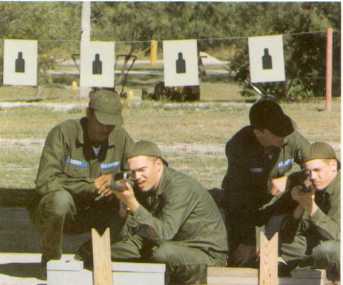
Most of shooting is about learning to "be still". Breath control and trigger control.
One of the best ways therefore to learn how to shoot better is to get an inexpensive red dot sight (any cheap one will do) and put it on a rilfe that has been "3 point checked" that it isn't loaded.
Put up a target at the end of the hallway, and aim at it. Watch how the red dot moves around, focus on keeping it still. (I'm not going to cover shooting mechanics in this post)
Now, squeeze the trigger slowly and watch how the dot moves. Cock and do it again, focus on zero movement all the way through the squeeze.
Do this laying down with the barrel supported, laying down with you holding it, sitting down, standing up, do it using a wall for cover.
Now do it while walking (crouched, step heel to toe). Focus on being able to hold your rifle with nearly zero movement in the dot of the scope still all the way until you hear the click of the firing pin ... no movement.
This is "target" practice that you can do at home without needing to spend a single cent on rounds.
Now, your rifle, unloaded will of course be a little lighter than it is with rounds in it. However, what you're after with this exercise is to give you the muscle memory to be able to fire with extreme accuracy without hardly thinking about it.
If you want to take this to another level, there are "lasers" that you can set into your barrel. These things put a laser dot on the wall and can make a neurosurgeon look like an epileptic. It's a way of learning to shoot with near zero movement to a whole new level.
If you want to learn to be a great shot, this is one way of getting that done because now you can practice much more often from the comfort of your home. You can improve your skill without really going anyway.
Hope this helps.
P.S. I know it's been quite a while since I last posted, but things got a little hectic. My apologies.
One of the things that most concerns me personally about any sort of survival situation is my kids. Will they know what to do, how will they react, etc.
To help with this I've started talking to them in the car. What would you do right now if there was a car accident and I was unconcious and my phone shattered?
In other words, I play a lot of "what would you do if ..." type of games in the car.
Interestingly they seem to REALLY enjoy it and have gotten in on the action themselves and started bringing their own "what would you do if..." scenarios to the table.
The great thing about this is that it's getting them to think about and consider survival situations and scenarios and reason out possible reactions ahead of an actual event. Our constant talking about this has "cemented" their responses to certain things.
Should there be some kind of natural disaster or something that forces me and my family to bug out (called the shit hitting the fan, or TSHTF for those new to this whole thing), I'm the kind of prepper that doesn't stock pile a whole lot. I want to grow, make, create, or hunt what I need.
There are a lot of pros and cons to this. On the Pro side, prepping this way is decidedly less expensive. Not only that, but learning how to create, I'm not even dependent on my specific bug out locations (BOLs) and could really bug out anywhere.
That said, doing things this way does have its Cons. The biggest of which to my mind is in "operations security" (OPSEC). In other words, gardens are visible. I live in ski country so my garden would need a green house during much of the year... which is still yet more visible.
Now, I have a plan for dealing with those things "as much as possible".
What I'm getting at here with this quick Saturday post is that there is no "perfect" or "right" way to prep and each method has its separate pros and cons. What is VITAL is for you to understand is the weak points are with even the METHOD you are using to prepare for some kind of disaster.
Knowing where you're weak can help you either fill those weak points or somehow use those weaknesses as an advantage.
This whole "prepper" thing is, for some good reasons, focused on survival when things go really bad. Long term survival off-grid with the supply chains broken and mobs of starving rioters running the streets, and/or surviving a full blown bug out.
The fact of the matter however is that there are many more "normal" disasters that we are likely to face.
Prep Level 1: Simple Power Grid Failure
Lets face it, at some point this is going to happen. Can you communicate with others and let them know you're okay? Can your loved ones get to you? Do you have some alternate method of power generation to keep your refrigerator working and a radio running?
Seriously, out of all of the things we need to be prepared for this is the easiest one, but the most often overlooked unless you have a prep plan that allows for you staying at home.
Prep Level 2: Car Malfunction At Worst Possible Time
Your car breaks down on a lonely road during a blizzard in the middle of the night. It's well below zero, visibility is a few inches.
Your car breaks down on a lonely road at noon in the middle of the desert. It's 120 in the shade and the heat causes disturbances in the air making it difficult to really tell what's up ahead.
In either of those cases you can COUNT on it occurring at the same time your cell phone is also mysteriously not working. You forgot to charge the battery, cell towers are down, snow from the blizzard is causing too much signal attenuation, or the nearest tower is simply too far away.
Now, we've heard of the Get Home Bag, and in the case of your car breaking down in the desert, IF you understand how to travel in the desert on foot, a Get Home Bag can literally mean you grabbing your bag, leaving your car, and doing it on foot. More likely, your "Get Home Bag" that you should keep in your car should be more considered a "stay alive in my car until someone comes by" bag.
The problem is that your Get Home Bag needs to change depending on where you are going to be traveling. The needs of someone in 120 Fahrenheit temps is obviously dramatically different than the needs of someone in sub zero temps.
Not only that, but of the two, the car break down during a blizzard is the worst scenario of the two as you could be stranded in your car for several days. Out in the desert it likely won't be more than a day. However, trying to stay in your car without it functioning in 120 degrees is problematic (your car would function like a giant greenhouse making it even hotter).
A quick word of note on this ... I really know what I'm doing in the snow and mountains. Despite that, If my car broke down during a blizzard and there was no one else around I would stay with my car. My "Get Home Bag" is packed for the mountains where I live. Survival chances during a blizzard drop dramatically when you leave your vehicle.
Prep Level 3: Localized Natural Disaster
The possibility of your power grid going down is a fairly likely event that most everyone will encounter sooner or later. Most of the country has experienced power grid failure for one reason or another that lasted multiple days and well into a week.
This is the first level where you need to worry about things like "Bug out bags" and "Bug out locations"
The possibility of your car breaking down is something most everyone has encountered though admittedly most of us break down on a major road and our cell phones work just fine. If you actually live in an area of extreme mountains or extreme desert then you already know that several people die every single year from cars breaking down and the person isn't prepared for it.
However, if you live somewhere that has tornadoes, a high possibility of torrential rain, hurricanes, "firestorms", or even earthquakes then you know that these events kill A LOT of people, often result in a break down in civil order, and generally things can get pretty ugly.
Katrina hopefully taught us all a valuable lesson regarding the government's ability to respond to something like this and how society will react.
Here is the problem with Localized Natural Disaster; with the exception of a hurricane, it can happen so suddenly that you can't get home to obtain your Bug Out Bag or if you can, your home won't still be there. This is where the "Get Home Bag" turns into a "Get To Your Bug Out Location" bag.
In my previous post I talked about "prepping your bug out location." Well folks, this right here is part of the reason for that. Your bug out location needs to be "ready enough" for your arrival even assuming you don't have your bug out bag ... because you might not have it. You may want to consider taking a look at the video below for assistance in getting your bug out location ready.
In fact, I would venture to say that unless the "localized natural disaster" is a hurricane, you stand a better than even chance of NOT having it. A hurricane is one of the very few massive natural disasters that gives fair warning of its arrival.
Those of you living in "tornado alley" are well away of how suddenly one of these puppies can take out a home. What if one goes through your neighborhood while you're at work?
What I'm saying is that your survival plan must include the possibility that you can't get to your actual Bug Out Bag!
For that matter, during that time of day it would mean children at school and possibly most of your other loved ones at work as well. What is your communications plan in the event of a breakdown in the usual communications system? Do your children know what to do? How will you communicate? I talked about communications in this post here.
Prep Level 4: Widespread Natural Disaster/National Breakdown In Civil Order This is what most of us are actually prepping for ... and it is the least likely to happen. In most of the first world, governments are quite careful not to push their citizenry so far that breakdown like this will happen and most countries are geologically diverse enough that no natural disaster could be that wide spread (except near extinction level events like a huge meteor strike).
Part of the reason I don't worry about storing years of food is that the likelihood of the above is so astronomically remote. In the event something like the above happens, like I've said in previous posts, I'm much more about growing/hunting/creating what I need than I am with stock piling.
What's The Point Of These Stupid Levels Anyway?
Here's the thing. I wanted to put up this post about the prep levels to create some understanding within our community. In my opinion there is far too much planning for PL4 (prep level 4) despite the fact that few of us are actually likely to see it in our lifetime.
Now I will admit that with the current financial mess the world is in PL4 via massive civil order breakdown caused by an absolute collapse in the global financial system is becoming more likely.
However, it is still far more likely that you will have to live through a PL2 or PL3.
So let me ask you ... if your car breaks down can you live in it? If there is a PL4 do you have a "Get Home Bag" that will get you home or to your bug out location?
Here is my point with all of this.
Lets plan for the most likely survival events we are likely to encounter. Especially since starting with the most likely events we might encounter makes us more prepared for the PL4 level events.
Having at least two defined bug out locations is important. Having them ready for you when you get there is just as important.
A good bug out location will be fairly remote, a little challenging to get to, but even better, it will be easily defended.
Once you've identified one of these close to you and another in a separate geological area, you need to start getting them ready. When you first arrive, you may not have any food left if you've had to walk any distance. That means your bug out location should have some buried food cache at a minimum.
Let me say that a bug out location is some place where you will not have day to day control over and that does mean some risk. I typically recommend "cheaper" food cache items for that reason.
However, as M.D. Creekmore pointed out in this post on the survivalist blog, storing food isn't really enough. You should also store some simple twine. It's cheap and a lot of it can be stored in a very small area. Additionally, some clothes pins so that you can clean and dry clothes.
I talk a lot about building a fire, but what about if it's too windy and a fire could create a very real dangerous situation? Or if it's raining? You need some kind of way of cooking that is enclosed. Now the article I linked to talked about a "cooking grill" ... personally, I have a simple metal box with no bottom and a lid on a hinge. A grill sits on supports.
Now I can cook in the wind or rain by putting the box around the fire.
Now you can get real fancy like I did and build in a method for transferring some of the heat from the fire into any tents or structures you have.
Next is some decent cast iron pans and the largest "stock pot" you can find. The stock pot doesn't need to be cast iron or anything. Just large enough to allow you to make soup ... or use to help get things clean.
If you want to get really smart ... put as many seeds for your garden into your bug out bag. Keep in mind the shelf life of the seeds you store so that you can rotate/replace as needed. This way you can get your garden going once you get to your bug out location. Personally I don't like to store much of anything at my bug out location that can go bad over time. Food is my only exception to that rule (and I store things with 20+ year long self lives so I'm okay). Seeds are small and light enough that you can keep a large variety of spring, summer, and fall items
Next, the article I linked to above talks about lamp oil. Personally, I think storing something that flammable is a bit foolish. It would be far better to learn how to make oil from animal fats or even better from roots or other vegetation at your bug out location.
Here's the thing. As much as possible you want to know how to make/acquire the things you need at your bug out location instead of stockpiling them. Things like rope/twine (at least for me) are a giant pain in the rear to make. Clothes pins are the same way. Ditto with something to stop your fire from killing you (or going out).
One more thing.
My view on bugging out, or surviving when the shit hits the fan, is admittedly different from a lot of people. I personally don't store much food. Instead, I have ways of growing my own food.
In fact, with preciously few exceptions, I want to be able to make, find/gather, or grow everything I'm going to need should there be grid/supply failures.
That means I'm not stockpiling much. Instead of spending money on stockpiling, I spend it on education. Learning about plants, animals, migration patterns where appropriate.
I spend my time on training and scouting locations and routes.
I would like to address a part of that post that actually only got about a paragraph. (please understand that's not a critique of the post, like I said it was fantastic ... one post can't cover everything)
The section had to do with communications.
Let me ask you a question, TSHTF (the shit hits the fan) and your family is all over the place. Does your family know where to go and what to do?
If one of you is delayed how will you communicate?
Understand something, in MOST major disasters your cell phone won't work either because towers are down, there's no power, or the phone system is being overwhelmed.
So how does communications occur?
What is your back up communications plan?
What about any children? How will you communicate with them should there be a widespread outage of the phone networks?
This article, also on the survival blog gives a great method for handling this.
Semi-recently I gave a post about what I thought should be in your bug out bag.
I have to admit something now. The list of items that I thought should be in a bug out bag was purposely incomplete.
That list included the obvious things.
It did leave a couple of things out, and I'd like to talk about one of them now ... plastic wrap.
In my opinion plastic wrap is a VITAL bug out bag item. In fact I also include plastic wrap in my go bag as well (meaning that list was also incomplete).
The reason that plastic wrap should be included has to do with it's versatility. It can be used to keep water out of things (or away from it), it can be used to assist with water generation (I'll explain this technique in later posts), it can be used in first aid, and so on.
I go to a "club store" like costco or sams club and I've got pretty large rolls of the stuff in my bags.
Think about including plastic wrap in your bug out bag.